Sunday, April 14, 2019

Mind over Matter: Soul vs. Brain

To me, it seems plausible that the mind could be explained by the brain, but it seems equally plausible (and to my metaphysical mindset, far more likely) that the mind is not explained by the brain, at least not fully. Bridging the gap between the physical and the non-physical has always fascinated me. It seems impossible to explain one by the other, as they seem to be two fundamental starting points or principles of reality. Even if the brain can explain the mind, the soul is not thereby explained away, nor is man fully explained.

Crick asserts that since the brain can explain the mind, then there is no need for a soul. But thinking and consciousness is not all that the soul does; hence the traditional distinction between mind and soul. How does one explain the difference between life and non-life, from the smallest bacterium to the largest mammal? The neuronal functionings do not seem to explain the life/non-life problem, while the soul, an anima-ting principle, does. Crick’s assertion would need to further answer the life/non-life problem in order to adequately show that there is no need for soul. He has only shown that there is no need for mind. The need for a soul cannot be explained away by the brain.

Fundamentally, there is a jurisdictional problem at play in this entire debate. The subject of our discourse is man qua man, a subject with immaterial and material elements, intellect and emotions, will and instinct. Modern academia has divided itself into disciplines with very specific jurisdictions and expertise areas, overall a positive development, unless such disciplines fail to interact with one another. Just like the Western intellectual movement towards individualism and the total self-sufficiency and independence of the individual from the group, each discipline has become wholly dependent upon itself, thereby assuming that its methodology—that which distinguishes one discipline from the others—is capable of explaining all of reality. But man is incredibly complex and intricate, an essentially interdisciplinary being. Hence any meaningful discourse on man must incorporate all the disciplines, for ultimately, all disciplines relate essentially to man. Man cannot be explained merely by metaphysics, nor can be explained merely by science. Man must be examined by a dialectic of all the disciplines. Only by such a dialectic can the essentially interdisciplinary being receive an adequate explanation.[1]


[1] Originally a Biology 402 final, 6 May 2015.


Eros as Revelation

Revelation and response as the cycle of love. ‘I have seen your beauty; I have seen you as you are; would you allow me to be in your life?’

The unconditional gift of love, the total gift of self as a response to the revelation of who the beloved truly is. 

Agape presupposes eros; precedes eros. Eros is the condition of agape.

God sees us as we are for He made us. God gives Himself to us absolutely unconditionally. We image Him as best we can. This is how we grow in love.  This is the intrinsic structure of love. 

In a postlapsarian world, the eros of the lover towards the beloved is a revelation of the goodness of the beloved to the beloved herself, who is blinded by the effects of original sin from fully seeing the truth of whom she is and who cannot behold the "truth of her being" without the revelation of the lover.[1]


[1] Originally notes from 24 Jan 2018, 7:55AM-9:49PM

Tuesday, April 9, 2019

Baroque Music and the Paradox of Tragic Beauty


J.S. Bach's Violin Concerto #1 in A Minor (BWV 1041) expresses perfectly one of the special properties of Baroque music generally and Baroque violin in minor key specifically. It captures a sense of beauty, with the high notes of the violin deeply moving the soul; at the same time these high notes have a sense of tragedy; of a piercing wound, not of the body, but of the soul. As the piece reaches the highest point, the other instruments become lighter allowing the violin to come to the forefront and emphasize the deeply personal nature of the tragic emotion. In a special way, Baroque music is able to capture the paradox of tragic beauty.[1]


[1] Originally an assignment for Music 201, 30 August 2013.

Wednesday, December 20, 2017

Makeup and Unmaking

I have long held plastic surgery procedures that irrevocably alter a person’s visage or other bodily features for no other reason than the person’s disdain for their natural appearance to be fundamentally immoral (in contradistinction to reconstructive surgeries that restore the creative work of God to its original beauty, in a manner akin to the restoration of an Old Master painting to its original beauty after it had been damaged by fire or flood). Makeup practices are non-permanent and therefore far less drastic than plastic surgery, but the same corrupt notion is at play—the hubristic presumption to ‘correct’ God’s masterpiece, as if a 5th grader assumed the artistic competence to pass corrective judgement upon a masterwork of Michelangelo.

Makeup as such cannot be deemed immoral, anymore than wearing beautiful clothing or cutting one’s hair in an accentuating style can be. Vestis virum reddit—“Clothes make the man”. Makeup is like a frame on an Old Master painting; no one goes to an art museum to view the frame, but without the accentuation of the golden wood surrounding the art itself, the piece would appear less luminous. Makeup qua accentuation of Divine Beauty inherent in the created physical person is indeed a morally commendable, though optional, act in adornment of the Temple of the Holy Spirit. But when makeup becomes a true ‘remaking’—a deconstructive practice whose specific goal is the desecrative correction of Divine Creation—it takes on the character of an impermanent pseudocosmetic unweaving of the Cosmos. Cosmetology for its own sake partakes of Satan’s repugnance for the created order and echoes the Satanic ‘Non serviam’.

Saturday, December 2, 2017

Philosophiæ Doctor a Scientist Doth Not Make

Must one be a Doctor of Philosophy to be a Scientist? A philosophical question.

An engineer of '90s PBS Kids fame by the name of Bill Nye “the Science Guy” has recently made many controversial headlines, contrapositioned by those within the “Scientific Community” who dismiss him and his statements as the simple opining of a mere engineer (pronounced with a lethal dosage of vitriolic venom). While this post takes no position with regard to the specific content of Mr. Nye’s statements, the recent controversy occasions a brief inquiry into the nature of what precisely constitutes the nature of “Scientist”—must one have been degreed a Philosophiæ Doctor (Ph.D.) to be a Scientist properly so called?

The Scientific Method prescribes certain criteria for a theory of natural phenomena to be held as generally valid, including rigorous and independently reproducible hypothesis testing. Such methodology necessarily presupposes peers of specialized, professional competence; hence the relegation of Natural Philosophy to the See of Academia, possessing plenary and exclusive jurisdiction over the theologians of “all things visible”.

With science thus wholly professionalized, all those lacking degreed credentials regulated by authority of the Academic See were henceforth declared anathematized. The scientific writings of non-scientists were systematically declared heretical by the Censor Scientiæ, and those claiming the title “Scientist” without the sanctioned ordination of the Academic See were declared excommunicated latæ sententiæ, notwithstanding the validity of specific truth-claims so advanced.

Those who dare defy the monopolistic power-grab of the Scientific Community are henceforth declared schismatic pseudo-scientists, wolves maliciously misleading the flock of secular citoyens.

But in the beginning it was not so.

The term scientist has a recent etymological gestation, brought to birth by the quasi-pontifical high priest of secular social theory Auguste Comte in the 1800s. Long before the Christian Era up until the dawn of the Modern, Natural Philosophy was the area of philosophic enquiry whose specific content encompassed the workings and wonders of the natural world. Natural Philosophy predates the Scientific Method, originating in Presocratic Greece, refined by Medieval Scholastics, and systematically developed by Renaissance thinkers of Neoplatonic Keplerian ilk.

Paradoxically, in the age of tyrants, monarchs, emperors and autocrats, the domain of licit scientific inquiry remained open to all persons, while in our own egalitarian age of parliaments, republics, populists and popularizers, democratic claim to legitimate science has been all but eradicated by the crippling totalitarian clutches of academic autocracy.

Natural Philosophy maintains no monopoly on the practice of systematic inquiry into the nature of the Cosmos; sed contra the ranks of natural philosophers are by nature open to any lover of wisdom who sincerely pursues the truth of physicality.

But in our New Dark Age, the democratic light of natural philosophy has now been all but extinguished, for a Ph.D. constitutes the prerequisite for attaining the rank of “Scientist” from which Academe grants no dispensation. Remedially, the Weltanschauung of Natural Philosophy must be restored to its rightful claim as definitional defender of those who profess the work of "Scientist", for if a genuine philosophia were again demanded of those declared Teacher of the Love of Wisdom, the swelling ranks of pseudo-scientific sycophants would surely begin to thin. 


(Mostly written 4 June 2017, 5:30pm; completed 2 December 2017, 6:30pm.)

Tuesday, July 12, 2016

Some Thoughts on Love

My love for her becomes my love for myself; my love for God becomes my love for her; my love for her becomes my love for God; my love for God becomes my love for myself; the two become one in spirit and body; the love for myself, for her, and for God forms an intrinsic unity in an image of Trinitarian Love.


Sunday, March 27, 2016

Philosophical Methodology vs. the Modus Vivendi of Authentic Philosophy

I’ll probably edit and expand this later, but I had this thought a few days ago[1] and just wanted to put it out there. Have a blessed Easter Sunday!

Academic “disciplines” are defined and constituted by their methodologies,[2] but philosophy does not have a “methodology” as such; it is a way of life, a modus vivendi ("mode of living"), a pursuit of truth in the broader sense, or the “love of wisdom” in the ancient and restricted etymological sense. Wherefore philosophy is not a “discipline” since philosophy as such transcends methodology qua modus vivendi.

“Schools of philosophy” may be considered “disciplines” since very often “schools” are defined not just by their founder or his works, but by his methodology, or by the methodology of extracting his thoughts and his way of thinking from his texts.

But such a narrowly-construed “philosophy” is dubitably philosophical, for in so reducing Philosophy to this-or-that methodology—and thereby creating a “philosophical discipline” properly so-called—the movement away from the “mode of living” has already been completed, for Philosophy is relegated to the solitary confinement of the academic department, cut off from communication with the broader world of wanderers, tourists, and pilgrims on their journey to the truth.

Only a way of living in pursuit of truth that transcends academic disciplinary methodology is worthy of the name Philosophy.


[1] Original fragment composed 25 March 2016, ~12:55-1:17am PST (Good Friday).
[2] This was a notion I argued for and discussed in my Theology 401 final essay, reproduced on Philosophical Living as “The Propriety of Magisterial Authority in Academic Theological Discourse”.

Tuesday, February 23, 2016

On the Necessary Similitude Between the Mythic and the Mundane

There has been much hype in the Star Wars community surrounding the infinite possibilities of havoc and hope which a Disney self-emancipated from any semblance of continuity with the entire artistic corpus of “The Maker” George Lucas—including, most especially, Lucas’ crowning masterpiece, The Prequel Trilogy—could reap upon the Star Wars franchise. But if one conjectured possibility—time travel or dimensional rifts—were admitted into Star Wars, it would fundamentally alter the similitude of “The Galaxy Far, Far, Away” (GFFA) to our own, thereby destroying the power of epic myth, in which there must be commonality and yet distance. The iconic opening line of the saga establishes the necessity of linear progression as the means of establishing a human manner of interacting with the GFFA: A long time ago in a galaxy far [, far] away… is only intelligible within the framework of our everyday experience vis-à-vis reality, that is, of a linear past and a three-dimensional expansion of space.
 
We exist in a linear progression of time; time travel would turn the epic into mere science fiction. By this I do not mean to imply that science fiction franchises such as Dr. Who, et al. are not amazing things in themselves, but nobody would contend that they contain the same power of epic myth that Star Wars always had since its very debut. These create interesting moral situations and things, but the element of time travel detaches them from our common experience of linear temporality, in which concrete actions and choices cause future results and which cannot be undone. Anakin's radical choice in Star Wars III is an example. He goes down the path of the Dark Side, and forever it "dominates his destiny". He cannot undo what he has done; he even remarks in horror at his fundamental choice "What have I done?!" while still in Palpatine's office; it is only in the linear progression of his actions and his son's actions that he is able to make a contrary choice; he cannot undo what was done, but—like us—he can make a choice for the good no matter how much evil has been done.[1]
 
There is a fundamental distinction, however, between going impossibly large distances in a short amount of time, and going back/forwards in time itself: the former is a mere variation of degree in a thing that bears familiarity; the latter is a fundamentally distinct kind of interaction with time. While I concede that the GFFA is not of necessity subject to our physical laws and often ignores them in the Saga itself—to the horror of a post-logical modern scientific establishment baptized in the name of the logically dubious methods of induction, inference, and generalization—I maintain that the physical laws of the GFFA should, in order to preserve the necessary similitude between our experience and the experience of the epic myth, be distinguished only in degree, and not in kind, regarding the effects—and not necessarily the causes—of those laws.[2]


[1] The preceding originally a Facebook comment, 5:55-6pm, 3 December 2015.
[2] The preceding originally a Facebook comment, 4:46pm, 4 December 2015.

Monday, November 30, 2015

The Logic of Mystery in the Concept of Analogy

“Analogy” must rise to the transcendental plane of mystery, for if it is reduced to mere logic then “analogy” as such is destroyed in metaphysical contradiction. This metaphysical contradiction—“metaphysical” as understood by Aristotelian logical philosophy—is being and not-being at the same time and in the same respect; it is the union and intersection of being different and the same, necessarily both at the same time and in the same respect, since without being the same in the same respect there could be no commonality between things related by analogy, while without being different in the same respect there could be no meaningful distinction between such things. This notion of simultaneously being the same and being distinguished in the same respect flatly contravenes logic, i.e. the Principle of Non-Contradition. The only way to save analogy is for it to rise above the plane of mere logic; analogia must retreat from logic to inhabit the plane of mysterium.[1]


[1] Originally thought of on 19 November 2015, 1:40-1:45am; Expanded 30 November 2015, 8:45-9:15pm PST.

Saturday, November 7, 2015

Star Wars and the Unfolding of Narrative Art

A certain Star Wars fan made the following social media remark regarding another Star Wars essay:
"his claim that Episodes I-III are supposed to be seen after Episodes IV-VI…is of course a total nonsense (those films wouldn´t be called Episodes I, II, III, IV, V and VI if that was true)"
I have written the following short essay in order to show that such claim, while it may be false, is by no means "of course a total nonsense".
 
I tried an experiment once: I had a friend who hadn't ever seen Star Wars and didn't even know the story (she was truly shocked when she learned that Darth Vader was Luke's father!). I told her, "I've never done this, but I want to try it: I want to introduce you to these films in their numerical order, but I'll skip the end of Star Wars III for a reason that will become apparent later, and we'll return to that after Star Wars VI.” She agreed.
 
Well, I had never closely watched these films ‘for the first time’ since I had actually watched them for the first time, and my dad showed me the Original Trilogy (IV, V, & VI) first, then the Prequel Trilogy (I, II, & III) second. I began to notice many subtle things that are 'assumed' in the Prequel Trilogy that are already covered in the Original Trilogy.
 
For example: In Star Wars II, the understanding of Obi-Wan's Jedi mind trick is assumed—and it isn't really explained in Star Wars I, but in Star Wars IV. The best two examples of all, examples which I think are beyond dispute, are the culturally ubiquitous "I am your father" of Star Wars V and the climactic Luke/Leia sibling reveal of Star Wars VI. In Star Wars III, these two dramatic twists are wrapped into one scene, the Padmé birth scene, but clearly these were never intended to be revealed in such an anticlimactic manner; these familiar facts are assumed knowledge during Star Wars III, allowing the birth scene to serve other purposes in the unfolding of the story.
 
One of the more subtle examples, but nevertheless very relevant, would be the music of Star Wars—all the themes composed by John Williams, and to a lesser extent, by Kevin Kiner. The “Force theme” appears in Star Wars IV and is subsequently developed in interesting ways throughout all six episodes (and The Clone Wars TV series). Countless themes make important variations throughout the entire saga, enriching the scenes with subtle meanings that are only fully appreciated when all previous appearances of such themes and variations have been encountered. John Williams, like George Lucas, cannot help but develop his compositions only in the manner in which he actually—outside of the “galaxy far, far away”—composed his works. The magnificent subtlety of the music of Star Wars, one of the strongest elements of the saga by Lucas’ own design, can only be fully interpreted and appreciated in the order in which the themes were actually developed, i.e. the order in which the movies were actually released.
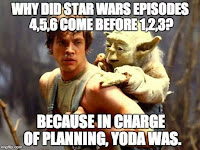
 
For the record, I like the Prequel Trilogy far more than the Original Trilogy, so my opinions should not be taken as adding a movement to the dissonant symphony of Prequel hate. My opinion regarding the proper order in which to watch the Star Wars movies does not spring from a belief that the Original Trilogy should be viewed first because it is better. It is not. I even used to agree with the position that the movies are best watched in their numerical ordering, which I now do not. I was never rigid on this matter, and I hope that other fans will give honest consideration to my argument before rejection or acceptance.
 
But I do think that it is best to watch the six episodes (and probably future spinoff ones—including The Force Awakens) in the order in which they came out from 1977-2005, not in their numerical ordering. Although the internal chronology is distorted by this, the fact remains that this is the order in which such films made their appearances in our real world, and a storyteller cannot help but reveal the unfolding story only in the order in which he actually makes it known publicly. I think this interpretive theory necessarily applies to all movie and book series, but it certainly applies to the six original Star Wars movies (and the subsequent Clone Wars series), the coherent corpus of Lucas' work, The Epic of Anakin as I like to call it.
 
Originally published as a social media comment on 9/21/2015. Edited for clarity on 11/7/2015.

The Propriety of Magisterial Authority in Academic Theological Discourse

Originally written 29 November-12 December 2014 as a final paper for Theology 401. I have corrected typos.

The Magisterium has an inherent right of judgment in theological discourse, without thereby derogating from the freedom of the academy.[1] Academic freedom is not destroyed by the perceived ‘interference’ of magisterial jurisdiction in academic discourse, for the raison d’ȇtre of the academy is precisely the pursuit and acquisition of truth, and theological truth properly inheres in and is thereby under the jurisdiction of the Teaching Authority of the Church, the Magisterium. This essay will explore the relationship between Magisterial authority and academic theology and will defend the Ratzingerian thesis by incorporating the thought of John Paul II and Cardinal Newman concerning theology, the academy, and the Magisterium.

            It is commonly thought today in the academic establishment—and it seems to me also in popular culture, or at least among the educated—that ecclesiastical authority is essentially foreign to the academic enterprise. With the sole exception of theology, I grant and defend this contention. While every other academic discipline is aimed essentially at the pursuit and acquisition of truth, from this it cannot be deduced that the Magisterium has jurisdiction in all matters of academic discourse.

All disciplines aim at truth, but not all truth is strictly speaking ‘theological’. Theological truth is that truth that concerns the Author of all truth, Truth itself. It is often fallaciously assumed from the divine title “Truth itself” that God is Truth in an all-encompassing, unqualified, univocal sense. In other words, it is often deduced from the “Truth itself” title that everything that is truth is a ‘part’ of Truth itself, that the resolution to the problem of the Univocity/Equivocity of Being is that being is unequivocally univocal. From this inaccurate deduction it is argued that all truth falls under the discipline of theology, thereby granting theology the status of Master Science under which all others are subsumed. As discussed above, the Magisterium has legitimate jurisdiction in theological matters. Therefore by this line of argument the Magisterium is granted jurisdiction over all academic discourse, since academic discourse is related to the truth, God is Truth, the truth is thereby essentially theological, and the Magisterium has jurisdiction over theological matters. This position cannot be responsibly maintained, either from the metaphysical stances regarding Univocity taken by the Magisterium during the Neoscholastic period, or by the Magisterial discussion of the proper relationship between faith and reason in St. John Paul II’s Fides et Ratio. In the thinking of John Paul, philosophy must remain faithful to its own methods as servant of the truth, so this precludes an excessive meddling in academic affairs.[2] However, John Paul also affirms that when philosophy touches upon the subject of God in its “ancillary” capacity, it thereby falls more directly under the legitimate jurisdiction of the Magisterium with regard to its truth-claims in a way similar to theology.[3]

Etymologically, “Magisterium” derives from magister, teacher. In the very notion of the Magisterium—the Teaching Office of the Church—lies the justification for its place in theology. It is the Church’s divine right to pronounce upon the subject of God and teach others the divine truths that have been revealed to her.

But the objection of the contemporary academic establishment—that rational argumentation, and not an authority external to the academy, should decide upon what is to be taught[4]—does seem reasonable and bears much weight. Why should “academic theology” exist as such? Why should theology be considered a science at all, accorded speculative rights in the academy?

Theology and the academy were not always together. With the rise of the university in the High Middle Ages, the proper locus of speculative theology was removed from the monasteries and monastery schools and transferred to the disputationes and lecture halls of the medieval academy.[5] Should not theology depart from the house of leaning and return to the house of prayer, the house of divine learning?

Mystical theology and other monastic theological traditions should be fostered, restored, treasured, and spread, but academic theology has its own right of existence, if not for the sake of itself, then for the sake all other disciplines. According to the thinking of Newman, theology belongs in the academy both because it is a form of universal knowledge (his university must teach all universal knowledge) and because without it the other disciplines would be essentially lacking. For Newman, every discipline belongs to a “circle of knowledge,”[6] each one modifying and supplementing the others, so that without any one discipline the circle would be essentially incomplete.[7] This is especially the case with theology, he argues, since theology is the “Science of God”[8] and its object transcends essentially the methodologies of all other sciences, at least in certain respects.[9] Theology complements the philosophical approach of the sciences. As John Paul teaches, theology helps philosophy grasp truths it would never have grasped,[10] and also corrects errors which would never have been corrected by mere rational argumentation.[11] The argument of Newman defends the rightful place of theology in the academy, and with this rightful place there comes magisterial jurisdiction over at least a sphere of academic discourse, i.e. academic theology.

In the last analysis, every discipline is defined by its methodology, and the methodology of academic theology necessarily incorporates the Teaching Authority of the Church as one of its constitutive elements. Magisterial jurisdiction is not foreign to academic theology; it contributes to its very essence as a discipline, since it is part of its methodology, its defining element. Academic theology deserves a place in the academy due to its character as universal knowledge concerning God, the author and source of all truth, the ultimate object of the academic enterprise. All truth-seeking leads either to God directly or in a roundabout way through the truth of metaphysical or material realities. The Magisterium properly has jurisdiction over theology in the academy, and this does not thereby weaken its position either as a methodologically-constituted discipline or as an intellectual endeavor. Rather, the Magisterium aids in the truth-seeking mission of the academy, the object of all academic pursuits and the object of academic theology.


[1] J. Ratzinger, “The Nature and Mission of Theology” (San Francisco: Ignatius Press, 1995) 45-46
[2] John Paul II, “Fides et Ratio” (Boston: Pauline Books & Media, 1998) §49
[3] John Paul II, §77
[4] J. Ratzinger, 47
[5] I forget where I read this historical critique. Please excuse my inability to cite its source properly.
[6] John Henry Newman, “The Idea of a University” (Notre Dame, IN: University of Notre Dame Press, 2013) 50
[7] Newman, 33-35
[8] Newman, 46
[9] Newman, 38
[10] John Paul II, §101
[11] John Paul II, §51

Friday, November 6, 2015

A Sketch of Love’s Treatment in The Brothers Karamozov

Written as a 2-hour paper for Humanities 402 on 14 April 2015. I have corrected typos in the original. The first three paragraphs make simple observations on the role of love, especially eros, in the novel, the fourth paragraph restates Zosima's ethical teaching regarding human love, and the final paragraph makes a genuinely philosophical contribution in the relationship between reason and emotion.


Different kinds of love recur frequently throughout The Brothers Karamazov. A very common love is romantic love, a love that seems to affect the plot itself, or to at least add intrigue and layering to character interaction.

Dimitri and his father Fyodor both fall in love with Grushenka. Both men seem not so much to want to love her and give their lives to her service so much as to defeat the other in competition and possess her as the object of their eros.

Later, after his father is murdered, Dimitri tries to gain the hand of his beloved. He finds out that she is involved with a Polish officer and is heartily disheartened. In the course of the evening, however, the Polish chap proves himself to be far more possessive than Dimitri ever was; it can be doubted whether the Polish man ever loved Grushenka, since he does not seem to care for her subtle feelings and openly insults Russia. At this point Dimitri proves that he does love her, truly, and that he wants what is best for her. It should be noted that he definitely thinks that what is best for her is to marry him, it still seems primarily motivated by true eros and not a perversion of erotic love.

Zosima exhorts his brethren to love everything, the trees, leaves, children, animals—everything. He teaches that everyone can love occasionally, even evil people. This statement seems surprising at first, but Jesus confirms this by saying ‘if you who are evil know how to do good to your children, how much more will you Heavenly Father take care of you?’. God loves all things all the time, since God is Love. Human persons, however, have trouble loving all the time. Zosima, therefore, urges his followers—and us—to strive to love all things at all times, since if all our energy is being spent on love than none can be spent on hatred.

The narrator provides a curious reference to love in the context of people jeering at Zosima and Alyosha’s reaction. Alyosha even questions why God has not vindicated his humble servant and made the holiness of Zosima apparent to all. The narrator recounts that he is glad that love gains the upper hand over reason in this instance, since a reasonable man will always come back to reason, but there are times when love must overrule reason. The narrator seems to create a divide between love and reason, at least certain types of love and reason. For Christians this is impossible in the strict sense, since God is Love and God is Logos. However, in a more general way, could this be possible? What does this divide mean? I think the narrator—and maybe the ‘author’—is trying to show us the limits of the “narrow Euclidian mind” that he wrote about. There are times when a certain kind of reasoning, formed by the strict application of logic to actions and events without any consultation, advice, or influence of emotions, is inappropriate. There are certain times when feelings trump reasonings. This is what Dostoevsky is showing us, that mere reason, reductionistic reason, Enlightenment reason is not the absolute indicator of propriety vis-à-vis reality. The emotions—strictly speaking ‘non-rational’ in themselves—must be consulted in making rational judgments and in taking action. Dostoevsky does not place a strict dichotomy between reason and love. He shows that love, not merely an emotion but certainly with emotional power, can sometimes overrule the “narrow Euclidian mind”. Sometimes it should. Sometimes it must.

Wednesday, October 7, 2015

Descartes' Restoration of Philosophical Methodology


This is probably my favorite short paper I wrote during college. It perfectly articulates my philosophy vis-à-vis the Neoscholastic establishment viewpoint—that Descartes caused the downfall of philosophy, and that Aristotle should be restored and Descartes suppressed by the authority of the academy—by arguing that Descartes was a true philosopher, restored philosophy, and that no true philosophy can “ruin” philosophy, while a tyrannically enforced false philosophy most certainly can.
It was written in Humanities 401 on 18 November 2014, as an expansion of the paper from 9 September 2014, with some elements incorporated from the paper of 13 October 2014. I have made slight revisions.
Has Descartes helped or hindered philosophy? Evaluate. 
Descartes has made a positive contribution to the philosophical enterprise. He asks questions that did not even seem to occur to the ancient or scholastic philosophers, and in so doing demonstrates his brilliant originality of thought. Any time valid questions are posed and arguments given it cannot be held that philosophy is ruined, for that is precisely what philosophy is, the posing and answering of questions and the response or refutation of such answers in a constant journey of the human intellect. The unabashed search for truth which philosophy is demands such honest inquiry, free from the impositions and constraints of a systematized fundamental world view.
Descartes sought to transcend these systematic constraints. In his commentary on the Meditations, Descartes states that no one has ever seriously doubted that he exists, that he has a body, and that other material things exist. Descartes simply wonders if it is possible to prove the existence of these things without relying upon the accuracy of the senses. Actual doubt is improperly attributed to Descartes, when he really was engaging in systematic doubt; he never actually doubted the things which he was ‘doubting’ in his thought experiment. He was simply raising a novel question: whether the things we commonly apprehend though the senses can be known without the use and accuracy of the senses.
This was an honest intellectual and philosophical inquiry which the academic establishment of his day—and the establishment of the contemporary Neoscholastic Catholic college—condemns as a fruitless and disordered departure from the ways of Aristotelian epistemology. Descartes should be commended for preserving the integrity of the philosophic enterprise, for a philosophy that simply hands down by the authority of the academy and the ancients ‘perennial truths’ somehow placed above the realm of disputation is not properly called “philosophy” so much as a common belief system akin to faith.
As J. Ratzinger distinguishes in Introduction to Christianity, faith comes from a community and the authority and loving trust thereof, whereas philosophy is born of the lone philosopher and its true understanding is based upon an evaluation of the arguments advanced in defense thereof. Philosophy is essentially disputative, and the authenticity of the philosophic enterprise is dependent upon an impartial search for truth. The element of ‘the teacher’ and ‘the taught’ dicens stricte destroys this authentic and disputative search by replacing it with ‘facts’ passed on by authority. Philosophy is reduced at best to a history of what has been thought or to a common credo of the true, and at worst to a dogmatism or quasi-ideology, an ‘ism’ which can explain everything by deduction from a single premise (cf. H. Arendt)—that Aristotelian modes of thinking are always correct. Descartes preserves the integrity of philosophy in his thought by preserving the integrity of properly philosophic methodology. He serves as a great reminder that cultural and historical assumptions should not limit the heights of philosophic discovery.
It is granted that Descartes began the downfall of the supremacy and unquestioned legitimacy of the ancient philosophy and the Scholasticism which had been built upon it—a systemic doubt caused by systematic doubt, as it were.[1] But the need to save a system or founding principle of a system, e.g. “All knowledge begins with the senses,” should never necessitate the dismissal of novel modes of inquiry. If a question is posed and a response is given, it does not serve the pursuit of truth merely to dismiss it based upon the principles of one’s own system. Rather the response should be addressed directly within the metaphysical framework in which the question arose. The historical result of Cartesian thought was the decline of the unquestioned dominance of Aristotelian, and consequently Thomistic, modes of thinking, but by so doing Cartesianism has restored philosophy to its proper methodological integrity, and Descartes has thereby helped philosophy. He has done this not by displacing Ancient or Scholastic thought—which are properly philosophic in themselves and deserve an equal place in dialogue with post-Cartesian modern philosophy—but by transcending the tyranny of prescribed modes of thought and thereby restoring the truly philosophic endeavor. Descartes gave to philosophy an entirely new way of viewing reality by following the rigorous and fearless methodology of truth-seeking, and the necessary fruits of such effort can never ruin philosophy. Only dogmatic insistence upon established modes of thought, for no other reason than the authority of the ages, ruins philosophy.


[1] I added “—a systemic doubt caused by systematic doubt, as it were.” on 7 October 2015, 7:25pm PST.

Sunday, September 6, 2015

"Original Instruments"

Last night I wanted to relax and read. I decided I wanted to listen to woodland bird sounds. I had my windows open, so the sound of peepers was very loud. I really didn’t want to hear them anymore, so I put on some bird sounds.


Spring Peeper
Then I realized something, something that I have been thinking about in relation to music recordings vs. live music: these frogs, crickets, and owls were singing to me; God has inscribed in their natures specific parts to play in the symphony of nature; the entire production was for my benefit as human person, the pinnacle of physical creation.

I would not listen to an mp3 of a classical piece if I were at a classical concert. Why would I listen to a pre-recorded nature when I had a front-row seat to the most splendid concert in the universe, with God my Creator conducting?

The symphony of nature is the composition of the Creator; maybe next time I want to “relax” to artificial reproductions of nature, I should listen to the magnificence of live performance on the ‘original instruments’, the actual creatures for which the natural symphony was composed.

Thursday, August 20, 2015

Reflections on Academia and Philosophical Methodology

There are many issues with contemporary academia; most scholars seem to acknowledge this, although their particular opinions on the issues and causes vary as much as Justice Kennedy’s opinions on the U.S. Supreme Court. I’ve been thinking about academia alot[1] lately; as a person who fancies himself a philosopher, and as a recent BA graduate, I have been thinking about the nature and interrelation of things such as “academia”, “the intellectual life”, and “philosophy”. Academia seems to maintain it has a monopoly upon the practice, or “profession” and “teaching”, of philosophy. But can “philosophy” really be a day-job? Can “philosophy” really be taught? Or does the nature of teaching philosophy actually corrupt the very nature of what is claimed to be transmitted? In other words, are the phrases “professor of philosophy”, “teacher of philosophy”, and “student of philosophy” actually contradictions in terms? Can “philosophy” be transmitted from teacher to student, or must it be practiced individually by the philosopher? What is the nature of that which is being transmitted from teacher to student, and is it true philosophy, or merely the faint resemblance of true philosophy, the outer appearance of true philosophy obscuring the essential corruption wrought by positivistic historical commentators?
Well if you cannot tell my answer to those questions, then you may need to take rhetoric lessons before you pursue authentic philosophy. In short, I think that philosophy cannot be taught or transmitted, that the very act of transmission properly understood corrupts the nature of the philosophical method, and that to understand philosophy, one must be a philosopher himself, one who analyzes the arguments of others in a dialectic of honesty in pursuit of truth. Such a methodology precludes “teaching” and necessitates active participation—“philosophizing”. Philosophy can only be philosophized among philosophers; it cannot be transmitted from teacher to student in an allegedly “philosophical” tradition, for such a tradition necessarily precludes authentic philosophy. Philosophy is better understood as a verb than a noun; the notion of “teaching” philosophy relies on the concept of philosophy as a positive corpus of thought produced by notable thinkers which can be dissected and fed to malleable students often incapably of true philosophy. Such academic passivity precludes philosophical activity.
The academy presses scholars by capitalist production to “produce” intellectual fruit through rigorous publishing requirements, which strangle genuine insight—that which must wait for the whim of the intellectus. Therefore academia is doomed to be positivist & merely historically descriptive, which has lead to its irrelevance and to the distortion of philosophy and the corruption of the very thinkers’ methodology.
Intellectual ideologies such as Radical Feminism and Neo-Thomism are not based on intellectus or ratio, but on anger and on the desire for bringing about a radical new world which they have envisioned as ideal, not so much as a result of their philosophy but as a goal towards which quasi-argumentative constructs which they would consider “philosophy” have been formulated. Since their conclusions have been preformulated, these “scholars” must conform reality and the free dialectic of truth to their narrow path toward their pre-ordained esoteric revelations. These movements (insofar as they can be classified as coherent “movements”) are not based on the quiet contemplation and intellectual activity of the truly philosophical life, but are falsifications of honest dialectics and are thereby disbarred from the category of authentic philosophy.


[1] I firmly hold that “alot” is a true word, due to continuous popular usage and the nature of verbal contraction as proven time and again with words such as “to-day”. I have accordingly chosen to revert my autocorrect.

Friday, July 10, 2015

In Defense of Marginalia

I have a delightfully diverse collection of old books; I acquired many discarded editions from my college library (my oldest item, a collection of Hindu sacred texts, dates to 1891). Some are in excellent shape, others not so much. But I am privileged to have a fairly large collection of fairly rare volumes.

I keep many on my large bookshelf so that when whim strikes I can take one off and browse for a while. (When I'm busy, they serve to taunt me and my work-a-day life). Today I picked up "The Art of Enjoying Art" by A. Philip McMahon (New York: Whittlesey House, 1938), a thorough volume on art appreciation and theory. But what struck me was a charmingly antediluvian Ex Libris tag on the inside front cover. It reads:
WHEN YOU USE A BOOK
  • Are you careful with it? 
  •  Do you try to keep it clean? 
  •  Do you refrain from writing or marking it? 
  •  Do you resist the temptation to roll up the corners of the pages and tear out little nips? 
  •  If so, good. 
  •  If not, try to think of books as human beings with feelings just like yours. And resolve today to treat books as friends.
While tearing out little nips constitutes a crime against posterity, the insinuation that marking or writing in a book constitutes abuse and a devaluing of the book's "human" dignity is flatly false. Let us for a moment take to heart what the last point commands: "try to think of books as human beings with feelings just like yours...[and] treat books as friends."

How many of you have friends that you merely observe or visually read? Now I'm not talking about "Facebook friends". I"m talking about real, deep, close friends; even best friends. Would you just stand in front of them for hours, awkwardly staring in silence? Or would you enter into a varyingly diverse dialogue of jocularity and empathy? Writing and marking in books serves as a quasi-dialogic exercise between reader and codex. While the book qua codex is unable to speak, the book qua vehicle of human intellection enters into dialogue with the reader on a deeply personal level, if only the reader accepts the invitation to listen, for without listening no dialogue can exist. In the words of Joseph Ratzinger ("The Nature and Mission of Theology" [San Francisco: Ignatius Press, 1995], pp. 32-33):
[D]ialogue does not take place simply because people are talking. Mere talk is the deterioration of dialogue that occurs when there has been a failure to reach it. Dialogue first comes into being where there is not only speech but also listening. Moreover, such listening must be the medium of an encounter; this encounter is the condition of an inner contact which leads to mutual comprehension. Reciprocal understanding, finally, deepens and transforms the being of the interlocutors.
The physical constitution of the codex receives the thoughts and ruminations of the attentive reader. Marginalia—book markings worthy of the name—form a dialogue with future generations as well, linking the living with the dead in a communion of thought. The reader thereby enters into a dialogue with the substance of the author's thought, a dialogue that transcends space and time, a metaphysical dialogue expressed through humble scribbles, a meeting of the physical and the metaphysical, of time and eternal truth.

Marginalia do not derogate from the inherent worth of the book anymore than tattoos derogate from the inherent dignity of the human person, body and soul. While they may detract from the value of the book [unless they are of some antiquity], if this is of concern to the private owner (in contrast to the library patron) then the owner is already treating his book not as a human being or friend with feelings, but as a slave, an intelligent subject acquired and sold for monetary gain.

I'm not seriously asserting that slavery exists in such framework, but if the goal is to treat books as human beings then they should not be expected to stay in mint condition until they can be sold. We should engage with them as objects of intelligence, and for many, marginalia serve as a means of dialogic encounter.